How Etsy Ads Actually Work (And Why Spending More Isn't Always the Answer)
If you've ever turned on Etsy Ads, set your daily budget, and wondered why Etsy isn't spending all of it, you're not alone.
I've spent years managing paid search campaigns and I've also worked with physical product businesses selling on Etsy, where advertising works a little differently than the campaigns many business owners are used to.
One of the biggest misconceptions I see is that setting a $25 daily advertising budget means Etsy is going to spend $25 every day.
That's not necessarily how it works. And sometimes, that's a good thing.
Let's talk about how Etsy Ads actually work, why your budget might not be spending, how to make your advertising more relevant, and why I think advertising can be worthwhile for small businesses selling physical products.
First, How Do Etsy Ads Work?
Etsy Ads allow sellers to pay for additional visibility within Etsy's search results and other advertising placements across the marketplace.
When someone searches for a product, Etsy considers which listings are relevant to that search. Sponsored listings can appear alongside organic search results, giving participating sellers an opportunity to reach shoppers who might not otherwise discover their products.
Unlike Google Ads, where advertisers can build keyword lists and manually control bids in many campaign types, Etsy handles much of the targeting and bidding automatically.
You choose which listings to advertise and establish a daily budget. Etsy's advertising system determines when and where those listings may appear.
And importantly, Etsy Ads generally operate on a cost-per-click model. That means you're paying when someone clicks your advertisement, not simply because your product appeared in their search results.
That means your advertising costs depend on factors like search demand, competition, listing relevance, and how often shoppers click. Seasonality (if applicable to your product) plays a big role here too!
Why Your Etsy Ads Might Not Spend Your Entire Daily Budget
Here's something that surprises a lot of sellers. You could have your daily advertising budget set to $25, but Etsy might only spend $10 that day.
I've managed accounts where the seller had their budget set at the highest amount available to them, and the campaign still wouldn't spend the full amount. That doesn't necessarily mean something is broken.
Your daily budget is a spending limit, not a spending guarantee.
Etsy needs opportunities to show your advertised listings to relevant shoppers. If there aren't enough searches, clicks, or competitive advertising opportunities for your products, the system may not use your entire budget.
For example, imagine you sell a very specific type of handmade Christmas stocking. There might be thousands of shoppers searching for Christmas stockings in November, but far fewer people searching for that product in March. Even if you're willing to spend $25 a day, there may simply not be enough relevant demand to generate that much advertising activity.
Your available budget doesn't create more shoppers.
Other factors can affect spending, including:
Search volume: How many people are actively searching for products similar to yours?
Seasonality: Is your product something people buy year-round or during a specific season?
Listing relevance: Does Etsy consider your product relevant to the searches happening?
Competition: How many other sellers are advertising similar products?
Click activity: Are shoppers interested enough in your listing to click when it appears?
If your budget isn't spending, my first recommendation isn't necessarily to increase it.
Instead, I want to understand whether there's enough demand, whether the listings are positioned correctly, and whether the traffic Etsy is finding is actually relevant.
You Can See Which Searches Are Triggering Your Etsy Ads
This is one of my favorite features of Etsy Ads, and one that I think more sellers should pay attention to. Etsy provides search-term reporting for advertised listings so you can better understand what shoppers are searching for when they interact with your ads.
Inside your Etsy Ads dashboard, you can review individual advertised listings and explore their search-term performance. This gives you insight into how Etsy is interpreting your products and matching them to shopper searches.
And sometimes, those matches aren't quite right.
A Real Example: Advertising Christmas Stockings Without Personalization
Let's say a shop sells beautiful handmade Christmas stockings, but they don't offer embroidered names or customization.
The seller might discover that their ads are appearing for searches like:
Personalized Christmas stockings
Custom name Christmas stocking
Embroidered Christmas stocking
Monogrammed Christmas stockings
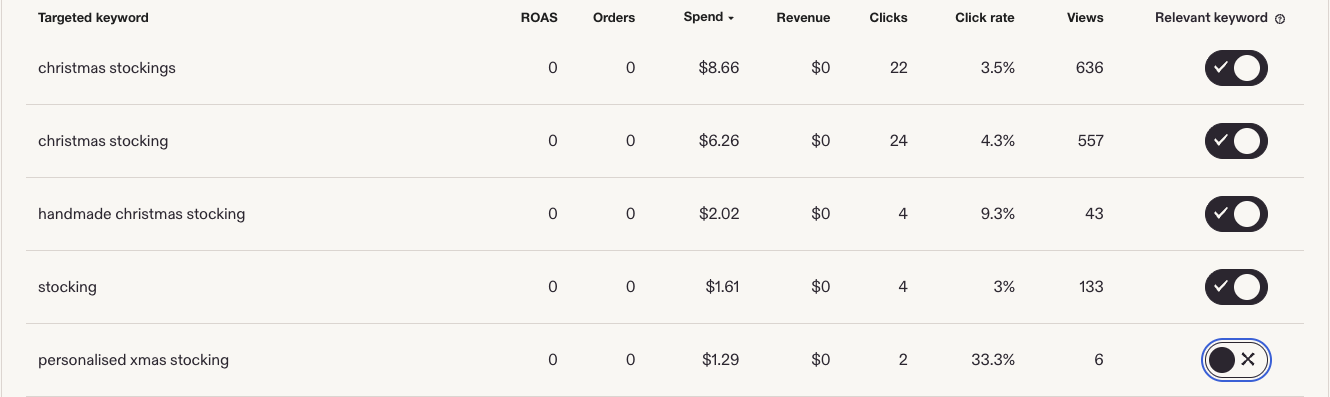
Those are relevant to the broader product category, but they're not relevant to what the shop actually sells.
Someone specifically looking for a stocking with their child's name embroidered on it probably isn't the ideal customer for a shop that doesn't offer personalization.
And if that shopper clicks the ad before realizing personalization isn't available, the seller may have just paid for a visit that was unlikely to convert.
This is why reviewing your search terms matters.
Etsy allows sellers to turn off certain search terms within the available search-term management controls for individual advertised listings.
For a shop that doesn't offer personalization, I'd review those customization-related searches and turn off the irrelevant ones where Etsy provides that option. The goal isn't necessarily to get fewer clicks. It's to get more qualified clicks.
I'd rather have 20 people visit a listing because they're genuinely interested in purchasing the product than 50 people visit because Etsy matched the listing to something the shop doesn't actually sell.
One important distinction: Etsy doesn't offer the same comprehensive negative keyword system you might be familiar with in Google Ads. Search-term controls are more limited, so it's important to review what's available within each listing's advertising data.
Your Etsy Ads Data Can Also Improve Your Organic Listings
Here's where I think things get especially interesting. Your advertising reports aren't just useful for advertising. They're also a window into how shoppers describe the products they're trying to find. A literal list of all the things people are typing into the search bar within the Etsy app.
You might discover that customers search for "vintage Christmas stockings" more often than the terminology you're using in your listings. Or perhaps people are searching for "cottagecore Christmas decor" when you've been describing your products as "traditional holiday decorations."
Those insights can help inform your listing titles, tags, descriptions, and even future product development.
Of course, you should only use keywords that accurately describe your products. But the more you understand how customers search, the better you can position your products for both paid and organic visibility.
This is something I've learned throughout my career in paid search: The best keyword research often comes from observing what real customers are already doing.
Are Etsy Ads Worth It? Let's Talk About Profit.
This is the part that doesn't get discussed enough. Advertising costs money. And when you're selling physical products, your profit margins already have a lot working against them. You've got materials, packaging, shipping, platform fees, and potentially labor costs. Add advertising on top of that, and suddenly a sale that looked pretty profitable might not leave much behind.
Let's look at an example from a real shop. You sell a handmade product for $35.
If you subtract
-$8 for materials and packaging.
-$3.5 in Etsy fees
-$7 attributed to Etsy Ads.
Remaining after fees: $16.50
Without advertising, that same sale would have left $23.50 before labor and other overhead. That's a meaningful difference! And I don't think sellers should ignore it. But here's the other side of the equation.
Would you have gotten that sale without advertising?
If the answer is no, then advertising may have helped generate $16.50 in contribution toward labor, overhead, and profit that you wouldn't otherwise have earned. That's why I don't automatically view advertising as a bad expense.
I view it as a customer acquisition cost.
The important question is whether that acquisition cost makes sense for your business.
This is a simplified example, not a complete Etsy profitability calculation!

Sometimes the First Sale Is Worth More Than the First Sale
This is probably my biggest perspective on Etsy advertising, particularly for smaller shops. When you're just starting out, you're not only trying to make sales. You're trying to build a business that shoppers feel comfortable purchasing from.
Think about how you shop online.
If you find two similar products, one from a shop with hundreds of sales and positive reviews and another from a shop with very little purchase history, which one are you more likely to trust? Most of us feel more comfortable buying from a shop that has an established track record. That's why I think it's important to look beyond the immediate profitability of an individual advertised sale.
A new customer can contribute to your business in several ways:
Building purchase history: Additional orders help establish a visible track record for your shop.
Creating review opportunities: Happy customers may leave reviews that help future shoppers feel more confident.
Increasing brand awareness: Someone who discovers your products through an advertisement may remember your shop later.
Generating repeat business: Depending on your product category, a first-time buyer might become a returning customer.
Helping you learn: Every purchase gives you another opportunity to understand which products, prices, and messages resonate with customers.
None of this guarantees that Etsy will reward your shop with higher organic rankings simply because you spent money on ads.
But there's real business value in building customer trust and a history of successful orders.
And for a small handmade business, that momentum can matter.
How Much Should You Spend on Etsy Ads?
I don't believe there's one perfect daily budget for every Etsy shop. A seller with $100 products and healthy margins has a very different advertising equation than someone selling $12 accessories.
Instead of picking an arbitrary number, I recommend working backward from your margins.
Ask yourself:
How much profit do I make on a typical order before advertising?
How much of that amount am I comfortable spending to acquire a customer?
How many advertising clicks does it typically take to generate a purchase?
Which products have enough margin to support advertising?
Are my ads generating additional sales, or am I paying for traffic that would have found me anyway?
Start with a budget you can afford to test, then monitor your results. You can always change it! I’d recommend a 2-3 week testing period before any major changes just so the algorithm can adjust and have a chance to actually drive sales, shooting for at least a month is a safer testing window.
I also wouldn't automatically advertise every product in your shop. Some listings have better margins. Others have stronger conversion rates or broader appeal.
If one product consistently attracts traffic but rarely converts, I'd want to investigate that before continuing to put money behind it.
And if another product consistently turns paid traffic into profitable orders, that's where I'd look for opportunities to invest more.
What Metrics Should Etsy Sellers Actually Watch?
You don't need to be a professional marketer to make better advertising decisions. But you should understand a few basic metrics.
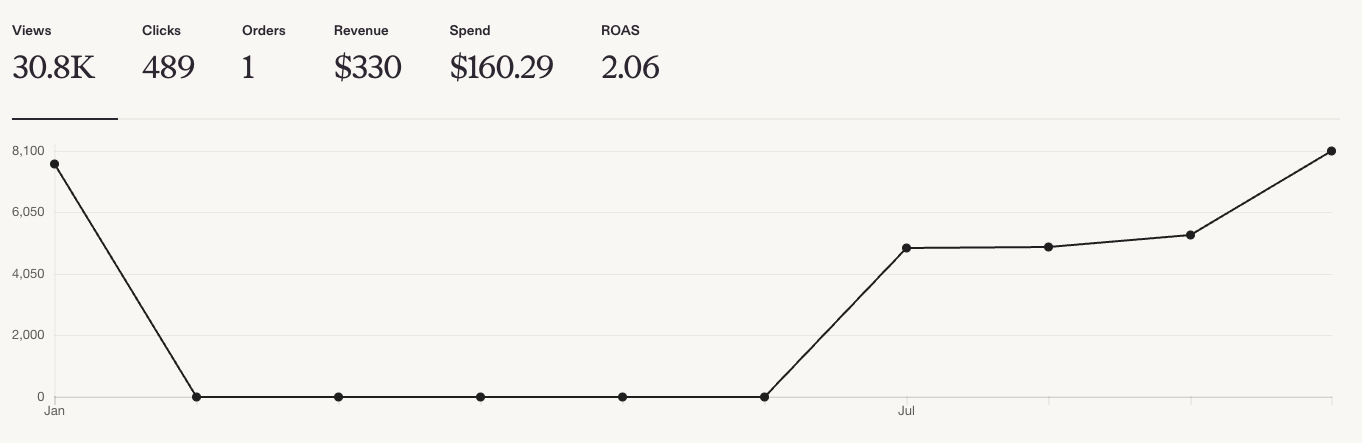
Clicks: How many shoppers are visiting your listings through ads?
Advertising spend: How much are you paying to generate those visits?
Orders: How many purchases are being attributed to your advertising?
Revenue: How much sales volume is being attributed to those ads?
Return on ad spend (ROAS): How much attributed revenue are you generating for every dollar spent?
For example, if you spend $50 on advertising and Etsy attributes $200 in revenue to those ads, your ROAS is 4.0. That means you generated $4 in attributed revenue for every $1 spent. But here's an important reminder:
ROAS is not profit.
You still have to account for materials, fees, shipping, labor, and other operating expenses. A 4.0 ROAS might be wonderful for one shop and unprofitable for another. That's why understanding your actual margins is so important!
My Recommendation: Don't Just Turn Etsy Ads On and Forget About Them
Etsy Ads are relatively easy to enable, which is part of their appeal.
You don't need to build complicated campaigns or learn an entirely new advertising platform. But easy setup doesn't mean you should stop paying attention. I recommend making a habit of reviewing your advertising performance, especially during busy selling seasons. Setting a 30-minute meeting with yourself every Tuesday is a great habit I recommend for my clients (or I can help you!).
Look at which listings are receiving traffic, which ones are converting, and which searches are bringing shoppers to your products. Turn off irrelevant search terms where those controls are available. Reconsider advertising products that aren't performing. And pay attention to seasonal changes in demand. Most importantly, don't panic if Etsy isn't spending your entire daily budget.
Sometimes there's simply not enough relevant traffic available, and spending more isn't automatically the solution.
The Bottom Line: Etsy Ads Can Be an Investment in Growth
I work in marketing, but I also understand what it means to run a small business where every dollar matters.
When you're selling something you've made, sourced, packaged, and shipped yourself, advertising expenses feel personal. You're watching money come directly out of your margins. And yes, some advertised sales will be less profitable than organic ones.
But advertising can also introduce your products to customers who might never have discovered your shop otherwise. Those customers can become sales, reviews, repeat purchases, and part of the foundation you're building for your business.
I don't think every Etsy seller needs to spend aggressively on advertising.
I do think sellers should understand how the system works, use the reporting tools available to them, and make intentional decisions about where their money goes.
Because the goal isn't to spend your entire advertising budget. The goal is to spend it on opportunities that actually help your business grow.
Need Help Understanding Your Advertising Performance?
I'm the founder of Ray Consulting Group, where I help small businesses make smarter marketing decisions through paid advertising, SEO, and practical digital strategy.
I believe good marketing should make sense for the business behind it, not just look impressive in a dashboard.
If you're trying to understand where your advertising dollars are going, which products deserve more attention, or how to build a stronger online presence, I'd love to help.

For makers who are ready to push things forward faster and show up more consistently.
What’s included:
Everything in The Steady Builder, plus:
Expanded SEO strategy + content creation
More frequent website updates + page builds
Etsy listing creation + keyword optimization
Social media management (more posts, more strategy, more consistency)
Deeper monthly strategy + performance tracking
Best for:
Makers who are ready to treat their business like a real growth engine and want a partner to help make it happen.
